


One of the most challenging aspects of OSHA recordkeeping is determining what actually needs to be recorded on your OSHA 300 Log. Make a mistake in either direction and you face problems: over-record and you artificially inflate your incident rates, potentially triggering OSHA inspections and increasing workers' compensation costs; under-record and you risk citations, penalties, and accusations of hiding safety problems.
The question "Is this recordable?" plagues safety managers, HR professionals, and business owners daily. An employee gets a splinter. Is that recordable? Someone twists their ankle and gets an ice pack. Recordable? A worker sees their doctor for a pre-existing condition that worsened at work. Now what?
This comprehensive guide cuts through the confusion, explaining exactly what makes an injury or illness recordable, how to classify different scenarios, and where employers commonly make mistakes.
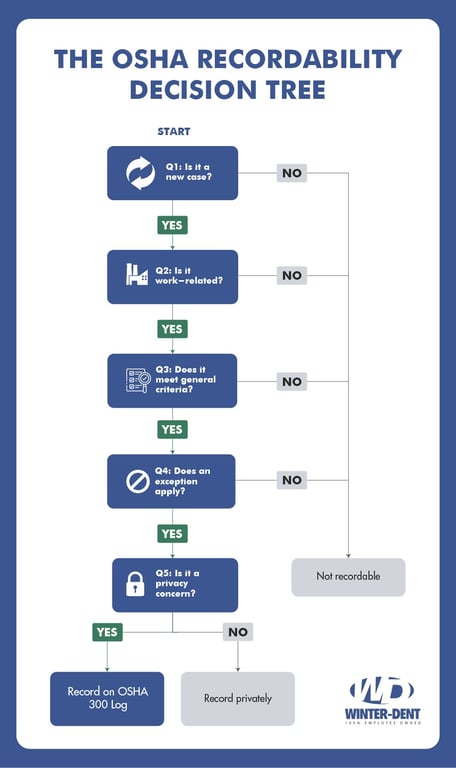 The Five Fundamental Questions
OSHA provides a decision tree for determining recordability. Every work-related injury or illness must pass through five questions:
Question 1: Is it a new case?
A "new case" is:
- An injury or illness that has not previously been recorded, OR
- A previously recorded injury or illness that has resolved and then recurs
Not a new case:
- Continuation of a previously recorded injury
- Follow-up treatment for an existing recorded case
- Ongoing monitoring of a chronic condition
Question 2: Is it work-related?
An injury or illness is presumed work-related if an event or exposure in the work environment either caused or contributed to the condition, or significantly aggravated a pre-existing condition.
The work environment includes:
- The establishment and other locations where employees are engaged in work-related activities
- Equipment or materials used
- Working conditions present
Key principle: If it wouldn't have happened but for the work, it's work-related.
Question 3: Does it meet the general recording criteria?
An injury or illness is recordable if it results in:
- Death
- Days away from work
- Restricted work or job transfer
- Medical treatment beyond first aid
- Loss of consciousness
- Significant injury diagnosed by a healthcare professional (cancer, fracture, punctured eardrum, etc.)
If the answer to all three questions is "yes," the case is recordable unless an exception applies.
Question 4: Does an exception apply?
Even if a case meets the general criteria, it may not be recordable if it falls under specific exceptions for:
- Personal tasks at the establishment (not work-related)
- Personal wellness activities (voluntary participation)
- Eating or drinking
- Common cold or flu
- Blood donation
- Occupational hearing loss testing
- Motor vehicle accidents in parking lots
Question 5: Is it a privacy concern case?
Certain types of cases have privacy protections and are recorded differently to protect employee confidentiality.
Now, let's dive deeper into the areas that cause the most confusion.
First Aid vs. Medical Treatment: The Critical Distinction
This is where most recordability questions arise. The difference between first aid and medical treatment determines whether many cases become recordable.
What OSHA Defines as First Aid
OSHA provides a specific, exhaustive list of treatments considered "first aid only." If the only treatment provided is on this list, the case is NOT recordable (assuming it doesn't involve days away, restricted work, etc.).
The First Aid List:
- Using non-prescription medications at non-prescription strength
- Over-the-counter pain relievers (aspirin, ibuprofen, acetaminophen)
- Antibiotic ointments
- Anti-itch creams
- Antacids
- Administering tetanus immunizations
- Tetanus shots alone are first aid
- Other vaccines (hepatitis B, rabies) are medical treatment
- Cleaning, flushing, or soaking wounds on the skin surface
- Washing with soap and water
- Flushing with saline or water
- Does not include cleaning wounds that penetrate below the skin surface
- Using wound coverings
- Bandages, Band-Aids, gauze pads, butterfly bandages
- Steri-Strips and similar non-invasive closure devices
- Using hot or cold therapy
- Ice packs
- Heating pads
- Heat/cold compresses
- Using non-rigid means of support
- Elastic bandages
- Wraps
- Non-rigid back belts
- Using temporary immobilization devices during transport
- Splints, slings, or backboards used only to transport to medical facility
- If continued after transport, becomes medical treatment
- Drilling a fingernail or toenail to relieve pressure
- Only for subungual hematomas (blood under nail)
- One of the few invasive procedures considered first aid
- Using eye patches
- Simple eye patches for protection
- Removing foreign bodies from the eye using only irrigation
- Flushing with water or saline
- Not using cotton swabs or instruments
- Removing splinters or foreign material from areas other than the eye
- By irrigation, tweezers, cotton swabs, or similar simple means
- Only from areas accessible without incision
- Using finger guards
- Simple protective coverings for injured fingers
- Using massages
- Physical therapy or chiropractic treatment is medical treatment, not massage
- Drinking fluids for relief of heat stress
- Providing water, sports drinks, or electrolyte solutions
What Counts as Medical Treatment
Anything NOT on the first aid list is considered medical treatment, making the case recordable. Common examples include:
Prescription Medications:
- Prescription-strength pain relievers
- Antibiotics (oral or topical)
- Anti-inflammatory medications
- Muscle relaxants
- Any medication requiring a prescription
Medical Procedures:
- Sutures (stitches)
- Staples
- Surgical glue (if applied by healthcare professional)
- Physical therapy
- Chiropractic treatment
- Injections (except tetanus)
- Debridement of wounds
- Cutting away dead tissue
- Application of rigid immobilization (casts, splints kept on)
Diagnostic Procedures with Findings:
- X-rays revealing fractures
- MRIs showing tissue damage
- CT scans with abnormal results Note: Diagnostic procedures revealing no injury are still considered medical treatment if ordered by a physician
The Gray Areas
Some scenarios cause confusion:
Scenario: Employee uses over-the-counter medication at home
- Still first aid if it's the only treatment
- Employee's personal use of OTC medication doesn't change classification
Scenario: Doctor recommends ice and rest, provides written instructions
- First aid because treatment itself (ice and rest) is on the first aid list
- A doctor's recommendation doesn't automatically make something medical treatment
Scenario: Employee goes to ER, receives only wound cleaning and bandage
- Still first aid if that's truly all that was done
- Location of treatment doesn't matter, only what treatment was provided
Scenario: Butterfly bandages used to close wound
- First aid (considered a wound covering)
- Regular adhesive bandage strips pulling skin together: first aid
- Medical adhesives or closure strips requiring professional application: medical treatment
Scenario: Prescription-strength ibuprofen (800mg) prescribed
- Medical treatment
- Even though ibuprofen is available OTC, prescription strength makes it medical treatment
Days Away from Work vs. Restricted Duty
When an injury or illness prevents an employee from performing their regular duties, you must determine whether it results in days away from work or restricted work activity.
Days Away From Work
Record days away when an employee:
- Is unable to work at all
- Works fewer hours than scheduled due to the injury/illness
- Is advised by healthcare professional not to work
Counting Days:
- Count calendar days, not just workdays
- Start counting the day after the injury occurred
- Count consecutive days, including weekends and holidays
- Stop counting when employee returns to full duty
- Count up to a cap of 180 days for a single case
- If employee never returns, record "permanently transferred" or note ongoing status at year-end
Common Mistakes:
- Forgetting to count weekends and holidays
- Stopping count when work-hardening or modified duty begins (should continue until full duty)
- Not updating the count as days accumulate throughout the year
Restricted Work or Job Transfer
Record as "restricted work" or "job transfer" when an employee:
- Cannot perform all routine job functions
- Cannot work full-time schedule they would otherwise have worked
- Is permanently assigned to a different job (even if it's lighter work they can do)
Examples of Restricted Work:
- Assembly line worker who cannot lift over 10 pounds
- Warehouse worker unable to operate forklift
- Office worker who can type but needs frequent breaks
- Maintenance worker who can work but not climb ladders
- Any employee working reduced hours due to the injury
Counting Restricted Days:
- Same rules as days away (calendar days, start day after injury)
- Continue counting until employee returns to full, unrestricted duty
- Cap at 180 days per case
- Days can be a mix of "away" and "restricted" for the same case
The "Full Duty" Standard
Employees return to full duty when they can:
- Perform all routine functions of their regular job
- Work all hours of their normally assigned schedule
- Do so without restrictions
Not full duty:
- "Light duty" assignments
- Modified tasks or reduced responsibilities
- Shorter shifts or more breaks
- "Stay close to the building" instructions
- "Desk duty" for normally active jobs
Alternative Work Programs
Many employers offer injured workers alternative assignments. How you handle these affects recordability:
Temporary Alternative Work: If you assign injured workers to different tasks they can perform while healing, this is still restricted work. The case is recordable with restricted days counted.
Permanent Job Transfer: If an employee is permanently assigned to a different job (even if it accommodates their restrictions), this counts as a job transfer. Record the case with a check in the "job transfer" column.
Volunteer Alternative Work: If an employee can perform their regular duties but voluntarily chooses to do different work, it's not restricted. However, you must document that:
- A physician placed no restrictions
- Employee could do their regular job
- Employee chose the alternative voluntarily
- Alternative work was not assigned due to injury
Privacy Concern Cases
Some injuries and illnesses are "privacy concern cases" that require special handling to protect employee confidentiality.
What Qualifies as a Privacy Case
OSHA automatically considers these privacy cases:
- Injuries or illnesses to intimate body parts or the reproductive system
- Sexual assault
- Mental illness
- HIV infection, hepatitis, or tuberculosis
- Needlestick injuries and cuts from sharp objects contaminated with another person's blood or OPIM
- Other illnesses if the employee independently and voluntarily requests privacy
How to Record Privacy Cases
On the OSHA 300 Log:
- Do NOT enter employee's name
- Write "Privacy Case" in the name field
- Keep a separate, confidential list linking the case number to the employee's name
- Otherwise record all details normally (date, location, job title, description, classification)
On the OSHA 300A Summary:
- Privacy cases are included in totals
- No names appear on the 300A anyway, so handle normally
Important: You cannot refuse to record a case because it's a privacy case. You must still log it with privacy protections.
Work-Related: The Often-Overlooked Qualifier
Even if an injury requires medical treatment, it's only recordable if it's work-related. This is where many cases get incorrectly recorded.
The Geographic Presumption
Injuries occurring on company premises during work hours are presumed work-related, but there are exceptions:
Not Work-Related Even at Work:
- Symptoms from non-work-related illness (employee's flu gets worse at work)
- Injuries from personal tasks (shopping online, personal grooming beyond washing hands/face)
- Injuries from personal disputes or violence unrelated to work
- Self-inflicted injuries
- Symptoms from eating contaminated food from outside source (not company cafeteria)
- Common cold or flu contracted at work
- Injuries from voluntary wellness activities (company gym, social sports)
The Home Office Exception
For employees working from home:
- Injuries are NOT presumed work-related
- Burden is on employer to prove work-relatedness
- Must occur while performing work for pay or compensation
- Must occur in dedicated workspace during work hours
Example: Employee trips over their dog while working from home office. Not recordable unless you can prove it was directly related to work activity.
Pre-Existing Conditions
The key question: Did work cause, contribute to, or significantly aggravate the condition?
Recordable:
- Employee with bad back throws it out lifting at work
- Pre-existing carpal tunnel syndrome worsens significantly due to work activities
- Diabetic's condition significantly worsens due to work stress or schedule
Not Recordable:
- Pre-existing condition follows its normal progression
- Medical treatment would have been needed anyway
- Work exposure was minimal or incidental
The "Significant Aggravation" Test: A pre-existing condition is significantly aggravated by work if:
- The condition deteriorates
- Medical treatment that wouldn't otherwise have been needed becomes necessary, OR
- The condition results in death, loss of consciousness, days away, restricted work, or job transfer
Special Recordability Situations
Some scenarios require extra attention:
Hearing Loss
Recordable only if:
- Employee's hearing test shows a Standard Threshold Shift (STS) of 10 dB or more in either ear
- Physician/audiologist determines the loss is work-related
- It's not temporary (must last beyond the workday)
Special rule: Age adjustment may be applied using OSHA's age correction tables.
Needlestick Injuries
Always recordable if:
- Contaminated with another person's blood or OPIM (Other Potentially Infectious Materials)
- Recorded as a privacy case
Not recordable if:
- Clean needle (no contamination)
- Employee's own medication injection
Musculoskeletal Disorders (MSDs)
Recordable if:
- Work activities caused or contributed to the condition
- Results in medical treatment, days away, or restricted work
- Diagnosed by healthcare professional
Common MSDs:
- Carpal tunnel syndrome
- Rotator cuff injuries
- Back strains
- Tendonitis
Documentation needed: Clear evidence that work activities caused or significantly aggravated the condition.
Mental Illness
Recordable only if:
- Employee experiencing mental illness
- Healthcare professional says it's work-related
- Results in medical treatment, days away, restricted work, or job transfer
High bar for work-relatedness: Must show workplace conditions directly caused the illness, not just contributed to stress.
When to Get a Physician's Opinion
You don't always need a doctor's determination, but it's wise to get professional input for:
Required Physician Determinations
- Significant injury diagnosed by healthcare professional
- Hearing loss (audiologist or physician)
- Respiratory illness (physician)
- Musculoskeletal disorders (when work-relatedness unclear)
- Any case where work-relatedness is disputed
Recommended Physician Input
- Uncertainty about whether treatment exceeds first aid
- Questions about restrictions (days away vs. restricted work)
- Pre-existing conditions that may have been aggravated
- Mental illness cases
- Needlestick exposure assessment
Document everything: Get written restrictions, treatment plans, and work-relatedness determinations in writing.
Common Recordability Mistakes
Employers frequently make these errors:
Mistake 1: Assuming ER Visit = Recordable
Wrong: "Employee went to ER, so it must be recordable." Right: "What treatment did the ER actually provide?"
If the ER only provided first aid (cleaning, bandaging, ice, OTC medication), it's not recordable just because it happened at a hospital.
Mistake 2: Recording First Aid Visits
Wrong: Recording every injury that goes to the company nurse, even if only first aid is provided. Right: Track first aid cases separately (good for trending), but don't record on OSHA 300 Log.
Mistake 3: Forgetting to Count Days
Wrong: Recording a case but not updating the day count throughout the year. Right: Track restricted/away days from injury date through return to full duty, updating your count regularly.
Mistake 4: Misclassifying Restricted Work
Wrong: Employee works "light duty" but you don't record restricted days because they're still at work. Right: If they can't do their full job, it's restricted work. Count every day until full duty return.
Mistake 5: Recording Non-Work Injuries
Wrong: Employee mentions they hurt themselves at home, but you record it because they discussed it at work. Right: Only work-related injuries are recordable. Document why non-work injuries are excluded.
Mistake 6: Waiting for Doctor's Note
Wrong: Not recording a case while waiting for the doctor to determine recordability. Right: Record within 7 days if it appears recordable; you can line through it later if the physician determines it's not work-related.
Mistake 7: Recording Diagnostic Tests with No Findings
Wrong: Recording a case because the doctor ordered an X-ray, even though it showed no injury. Right: If the X-ray reveals no injury and no treatment was provided beyond first aid, it's not recordable.
Mistake 8: Ignoring the Calendar Day Rule
Wrong: Counting only workdays for days away or restricted. Right: Count every calendar day, including weekends and holidays.
The Gray Areas Employers Struggle With
Some scenarios don't fit neatly into OSHA's rules:
Gray Area 1: Butterfly Bandages vs. Stitches
The Confusion: Butterfly bandages hold wound closed like stitches. The Ruling: Butterfly bandages, Steri-Strips, and similar adhesive closures applied by employer or employee = first aid. Medical adhesives or closure strips requiring professional application = medical treatment. The Reality: This is a fuzzy line. When in doubt, document your reasoning.
Gray Area 2: "Come Back if It Gets Worse"
The Scenario: Doctor examines employee, provides no treatment, says "come back if it gets worse." The Question: Is the exam itself medical treatment? The Answer: If the doctor only examined and recommended over-the-counter treatment, it's first aid. The examination alone isn't medical treatment unless a significant injury is diagnosed (fracture, torn ligament, etc.).
Gray Area 3: Work-Hardening Programs
The Scenario: Employee is in a physical therapy work-hardening program, gradually increasing activity. The Question: Are these restricted days? The Answer: If employee cannot yet perform full job duties without restriction, continue counting restricted days. Once they can do full job (even if still in program), stop counting.
Gray Area 4: Prescription Medication That's Also Available OTC
The Confusion: Ibuprofen is OTC, but doctor prescribes 800mg tablets. The Ruling: Prescription strength = medical treatment, even if the same drug is available OTC at lower strength. The Exception: If employee could achieve same result by taking multiple OTC tablets, some argue it's first aid. OSHA generally says prescription strength = medical treatment.
Gray Area 5: Chiropractor Adjustments vs. Massage
The Confusion: Massage is on the first aid list, but chiropractic isn't. The Ruling: Chiropractic treatment (spinal manipulation, adjustments) = medical treatment. Simple massage = first aid. The Challenge: Determining whether chiropractor provided treatment or just massage. Get documentation.
Gray Area 6: Employee Refuses Medical Treatment
The Scenario: Injury warrants medical care, but employee refuses to see doctor. The Question: Is it recordable if we don't know what treatment they received? The Answer: If you have reason to believe the injury would require more than first aid, record it. Document the employee's refusal of medical treatment.
Gray Area 7: Ongoing Pre-Existing Conditions
The Scenario: Employee has chronic back problems, tweaks it at work, gets same treatment as always. The Question: Is each flare-up a new case or continuation of old one? The Answer: If it's a recurrence after the employee had returned to normal function, it's a new case. If it's ongoing chronic condition without resolution, it's not a new case (but may still be recordable if it meets recording criteria and this is the first time it's being recorded).
Gray Area 8: Off-Site Work Injuries
The Scenario: Employee traveling for work, injured at hotel gym before work day starts. The Question: Work-related or not? The Answer: Generally not work-related if the activity was personal (using hotel gym voluntarily). Would be work-related if the injury occurred while doing work-related activities, even at off-site location.
The Over-Recording Problem
While under-recording gets more attention, over-recording causes real problems too:
Why Employers Over-Record
Fear of Citations: "When in doubt, record it" seems safe, but it inflates your incident rates unnecessarily.
Lack of Training: Employees making recordability decisions without proper training record everything to be "safe."
Pressure from Workers' Comp: Some think everything that generates a workers' comp claim must be recorded on OSHA 300 Log. Not true.
Confusion About First Aid: Not knowing what's on the first aid list leads to recording cases that shouldn't be recorded.
The Costs of Over-Recording
Higher Incident Rates: Artificially inflated TRIR and DART rates make you look less safe than you are.
OSHA Targeting: High rates trigger Site-Specific Targeting, leading to inspections you could have avoided.
Workers' Comp Impact: Poor safety metrics can affect your experience modification rate and premiums.
Competitive Disadvantage: Bidding on contracts may require safety metrics. Inflated rates hurt your competitiveness.
Employee Perception: Appears your workplace is more dangerous than it actually is, affecting morale and recruitment.
How Technology Helps With Recordability Decisions
Making accurate recordability determinations requires knowledge, consistency, and documentation. This is where modern technology like OSHAlogs makes a crucial difference.
Guided Decision-Making
OSHAlogs provides:
- Step-by-step questionnaires based on OSHA's decision tree
- Built-in first aid list so you can quickly verify if treatment qualifies
- Automated classification based on your answers
- Consistent criteria applied every time, regardless of who's making the decision
Instead of:
- Trying to remember which treatments are first aid
- Flipping through OSHA's recordkeeping handbook
- Making different decisions for similar cases
- Second-guessing yourself
Expert Guidance When You Need It
OSHAlogs offers:
- Context-sensitive help for difficult scenarios
- Access to recordability experts when you're unsure
- Real examples showing how similar cases were classified
- Documentation prompts to capture all necessary information
Avoiding:
- Paralysis when facing gray areas
- Inconsistent handling of similar situations
- Missing critical documentation
- Recording cases that shouldn't be recorded
Automatic Day Counting
OSHAlogs handles:
- Calendar day calculations from injury through full duty return
- Automatic updates as days accumulate
- Reminders to check status and update counts
- 180-day cap applied automatically
No more:
- Forgetting to count weekends
- Losing track of ongoing cases
- Manual calendar counting
- Updated forms with wrong day counts
Consistency Across Locations
For multi-location businesses:
- Standardized criteria applied at all sites
- Centralized decision support ensuring consistency
- Comparison reports identifying locations that classify differently
- Training tools bringing everyone to the same standard
Documentation and Audit Trail
OSHAlogs maintains:
- Complete record of information considered
- Justification for each classification decision
- Timeline of when decisions were made
- Supporting documents attached to each case
Valuable for:
- OSHA inspections (showing your decision-making process)
- Workers' compensation audits
- Internal reviews
- Training new personnel
Real-Time Training
As you use OSHAlogs:
- Learn OSHA criteria through guided questions
- See explanations for why cases are classified certain ways
- Build knowledge over time
- Reduce errors through consistent reinforcement
Trend Analysis
OSHAlogs reveals:
- Patterns in your recordability decisions (are you over-recording?)
- Comparison to industry norms (do you classify similarly to peers?)
- Common injury types at your facility
- Training needs based on decision patterns
Best Practices for Recordability Decisions
Follow these guidelines to make accurate, defensible determinations:
1. Designate Trained Decision-Makers
Don't let everyone decide recordability:
- Assign specific individuals responsibility
- Provide comprehensive training on OSHA criteria
- Update training annually
- Document their qualifications
2. Use Consistent Criteria
Apply the same standards every time:
- Follow OSHA's decision tree systematically
- Document your reasoning
- Review past decisions for similar cases
- Don't let personal relationships influence classification
3. Document Everything
For every case, record:
- Date and time of injury
- Detailed description of how it occurred
- Exact treatment provided
- Who provided treatment
- Healthcare provider's determinations
- Work-relatedness assessment
- Your recordability decision and reasoning
4. Get Medical Professional Input When Needed
Don't guess on medical questions:
- Work with treating physicians
- Ask specific questions about work-relatedness
- Request written restrictions
- Get clarification on treatment provided
5. Track First Aid Separately
Maintain a first aid log:
- Shows you're attentive to all injuries
- Helps identify trends before they become recordable
- Demonstrates you're not hiding incidents
- Useful for internal safety analysis
6. Review Decisions Periodically
Conduct quarterly reviews:
- Audit a sample of recordability decisions
- Check for consistency
- Identify areas needing more training
- Correct any errors found
7. Seek Expert Help for Gray Areas
When uncertain:
- Consult with safety professionals
- Contact OSHA's recordkeeping helpline (1-800-321-OSHA)
- Work with your insurance carrier's loss control team
- Use OSHAlogs' expert consultation features
8. Err on the Side of Recording
When genuinely uncertain after research:
- Record the case
- Document why it's questionable
- You can always remove it later if you get clarification
- It's better than facing citations for underreporting
The Bottom Line on Recordability
Accurate injury classification isn't just about compliance. It's about:
Understanding Your True Safety Performance: Only accurate data shows you where real problems exist and where your efforts should focus.
Making Fair Comparisons: You can't benchmark against industry averages if you're not classifying cases the same way.
Avoiding Unnecessary Scrutiny: Both over-recording and under-recording attract OSHA attention for different reasons.
Building Credibility: Employees, regulators, and business partners trust employers who handle recordkeeping with integrity.
Supporting Injured Workers: Proper classification ensures injured employees get appropriate treatment and follow-up care.
The good news is that recordability doesn't have to be a mystery. With clear criteria, proper training, good documentation, and the right tools, you can make confident, accurate determinations that protect your employees, your business, and your reputation.
Get Expert Help With Recordability Decisions
Winter-Dent understands that recordability determinations can be challenging. Our safety experts are available to help you navigate difficult cases and ensure your OSHA recordkeeping is accurate.
We can help you:
- Review specific cases to determine correct classification
- Audit your existing records for accuracy and consistency
- Train your team on OSHA recordability criteria
- Develop decision-making procedures for your organization
- Handle gray areas with expert guidance
- Prepare for OSHA inspections with confidence
Don't let recordability questions keep you up at night. Contact Winter-Dent for a complimentary review of your recordkeeping practices. We'll help you identify any issues and ensure you're classifying injuries correctly.

Let OSHAlogs Take the Guesswork Out
Ask Winter-Dent about OSHAlogs, the recordkeeping platform that makes classification easy:
- Step-by-step guidance through OSHA's decision tree
- Built-in first aid list for instant reference
- Expert consultation for difficult cases
- Consistent criteria applied every time
- Complete documentation of your decision-making
- Automatic day counting for restricted/away cases
- Training built in as you use the system
Winter-Dent provides OSHAlogs to clients at no additional cost, ensuring you have the tools you need to maintain accurate, compliant records.
Schedule a demo today and see how OSHAlogs eliminates recordability confusion while keeping you audit-ready. In just 15 minutes, we'll show you how the platform guides you through even the trickiest classification decisions.